
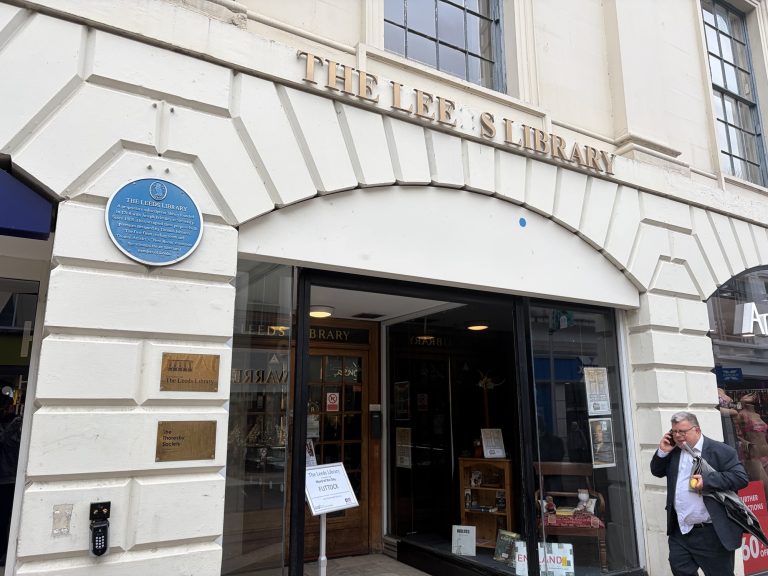

The copy resides in Leeds Library and explores an English knight’s journey to jerusalem, according to Head Librarian Jane Riley.
Jane said the book is “very early printing and it’s hand illuminated in red” going on to describe how the text is “all in Latin, but the story is a lovely book”.
The travel journal is one of 140,000 books in the collection, which Ms Riley said “reflects the people of the city”.
The members-only organisation has been at its current site on Commercial Street since 1808, but was founded in 1768 – almost a century before the city’s first public library.
On Tuesday, Jane gave a talk at Kirkstall Abbey as part of the Leeds 400 celebrations, which commemorates the city receiving its first Royal Charter from King Charles I.
Ms Riley talks about how members have always been able to request books for the collection, shaping the shelves personally. “What we have here reflects the reading taste of the library members of the last nearly 260 years” she said.
‘We’re seen as a bit of a hidden gem where we are’
She adds that the collection provides “a good cross section” of different people in Leeds’ history. Works in the collection vary from 1970s poetry by Tony Harrison to contemporary plays by Alan Bennett, displaying the city’s diverse culture and evolution.
The institution also holds “over 7000” victorian and earlier novels, which have gone “in and out of fashion as years have passed.” Jane believes this reflects how reading taste has changed as Leeds has grown.
The collection even holds a rare original copy of Herman Melville’s “The Whale” which was later changed to “Moby Dick” just one month later.
Jane’s passion to preserve Leeds’ local history is shared by Dr Henry Irving, Lecturer at Leeds Beckett. Dr Irving said “I think there is something quite distinctive about local history because it’s kind of tangible, you can see it and you can touch it”.
Dr Irving said “Leeds is a big city, so it’s experienced some big things, but it’s also got plenty of more interesting personal stories as well”, going on to say how it allows for a “sense of local identity.”
Henry said local history can help people feel connected to places around them. “It’s a way of feeling rooted in a place” he said. “Those stories are a way of bringing people together”.